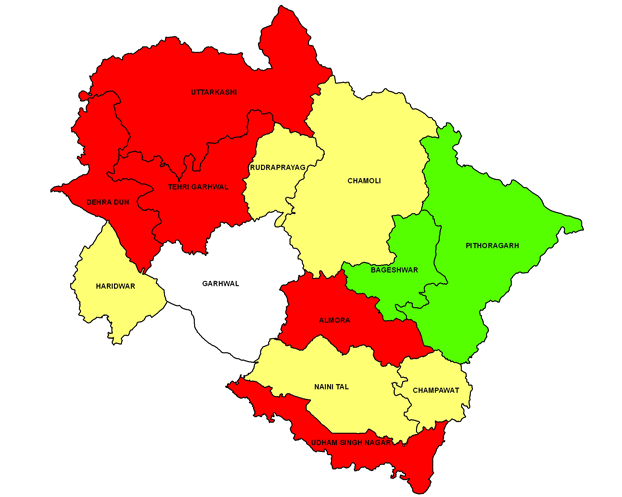
The state of Uttarakhand is located in the northwestern part of the country. It is bordered by the Indian state of Himachal Pradesh to the northwest, the Tibet Autonomous Region of China to the northeast, Nepal to the southeast, the Indian state of Uttar Pradesh to the south and southwest, and a small part of the Indian state of Haryana to the west. . Its capital is the north-western city of Dehradun.
On November 9, 2000, the state of Uttaranchal – the 27th state of India – was carved out of Uttar Pradesh, and in January 2007 it was renamed Uttarakhand, meaning “northern region”, which was its traditional name. Area 19,739 sq mi (51,125 sq km). pop (2011) 10,116,752.
Land
Relief
Uttarakhand has a highly varied topography with snow-capped peaks, glaciers, deep valleys, thundering streams, beautiful lakes and some patches of dusty plains in the south. Some of the highest mountains in the world are found in Uttarakhand. Notably, these include Nanda Devi (25,646 ft [7,817 m]), the second highest peak in India, Kamet (25,446 ft [7,756 m]), and Badrinath (23,208 ft [7,138 m]).
Uttarakhand can be divided into several physical regions, all running parallel to each other from northwest to southeast. The northern region, known as the Himadri, includes the Zaskar and sections of the Great Himalaya range, ranging from 10,000 to 25,000 feet (3,000 to 7,600 m). Most of the major peaks are located in this area. Near and south of the Great Himalayas is a region with a portion of the Himalayas, known as Himachal, with elevations between about 6,500 and 10,000 feet (2,000 to 3,000 m); There are two linear ranges in this zone – Mussoorie and Nag Tibba. To the south of Himachal lies the extension of the Siwalik range. The entire region consisting of Himadri, Himachal and Siwalik is broadly known as the Kumaon Himalaya. The southern edge of the Siwalik range merges with a narrow bed of gravel and alluvium, known as the Bhabar, which in the south is known as the Terai. The combined Siwalik-Bhabar-Terai region ranges in altitude from 1,000 to 10,000 feet (300 to 3,000 m). To the south of Siwalik are flat-floored depressions, known locally as duns, such as Dehradun.
Drainage
The state is drained by various rivers of the Ganga (Ganga) system. The western watershed consists of the river Yamuna and its major tributary Tons. To the east of this basin flow the Bhumi Bhagirathi and the Alaknanda – which join to form the Ganga at the city of Devprayag. To the east again are the south-flowing Ramganga and Kosi rivers, and in the same region are the south-flowing Sarju and Goriganga, both of which meet at Kali on Uttarakhand’s eastern border with Nepal.
Soil
Uttarakhand has a variety of soil types, all of which are susceptible to soil erosion. In the north, soils range from gravel (debris from glaciers) to hard clay. Brown forest soils – often shallow, gravelly, and rich in organic matter – are found far to the south. The Bhabar region is characterized by soils that are coarse-textured, sandy-gravelly, highly porous and largely infertile. In the extreme southeastern part of the state, Terai soil is mostly rich, mixed to varying degrees with clay loam, fine sand and silt; They are suitable for rice and sugarcane cultivation.
Climate
The climate of Uttarakhand is temperate, marked by seasonal variations in temperature but also influenced by tropical monsoons. January is the coldest month, with average high temperatures below freezing in the north and near 70 °F (21 °C) in the southeast. In the north, July is the hottest month, with temperatures typically rising from the mid-40s F (about 7 °C) to about 70% F daily. In the Southeast, May is the hottest month, with daily temperatures typically ranging from around 80 °F (27 °C) to the low 100s F (about 38 °C). Most of the state’s 60 inches (1,500 mm) annual rainfall is brought by the southwest monsoon, which lasts from July to September. In the lower parts of the valleys, floods and landslides are a problem during rainy season. Between December and March, 10 to 15 feet (3 to 5 m) of snowfall is common in the northern parts of the state.
Plant and animal life
Uttarakhand has four major forest types, including alpine grasslands in the extreme north, temperate forests in the Great Himalayas, tropical deciduous forests in the Lesser Himalayas, and thorn forests in parts of the Siwalik Range and Terai. According to official data, more than 60 percent of Uttarakhand is covered by forests; In reality, however, the coverage is very low. Forests not only provide firewood and fuelwood, but are also extensive grazing lands for livestock. Only a small fraction of the total land area of the state has permanent pastures.
Common tree species of temperate forests include Himalayan cedar (Dedar Dedar), Himalayan (blue) cedar, oak, silver cedar, spruce, chestnut, elm, poplar, birch, yew, cypress, and rhododendron. Tropical deciduous forests of namkeen, teak and rosewood – all found in the hardwood-submutane tract. Dhak ke kante (a type of flowering tree), babul (a type of acacia), and various shrubs are found in the south.
West in Uttarakhand Shu is a rich array of life. Tigers, leopards, elephants, wild boars, and sloth bears are among the state’s large mammals. Common birds include pigeons, doves, ducks, mallards, peacocks, jays, quails and woodpeckers. Crocodiles are found in some areas. Lions and rhinos have become extinct in the region. Many national parks and sanctuaries have been established to protect the wildlife of Uttarakhand.
People
Population Structure
Uttarakhand has a large population spread over two major geographic regions: Gahdwal, which roughly corresponds to the northwestern half of the state, and Kumaon, which lies in the southeast. Rajputs (various clans of landed lords and their descendants)—members of the indigenous Garhwali, Gurjar, and Kumaoni communities—as well as many expatriates form a large part of the population. Of the total population, about one-fifth belong to Scheduled Castes (an official designation for those groups who traditionally occupy a lower position within the Indian caste system); These people are collectively called Kol or Dums. Scheduled tribes (an official category embracing indigenous peoples outside the Indian social order), such as the Rajis, who live near the border with Nepal, make up less than 5 percent of the population.
Most of the people of Uttarakhand speak an Indo-Aryan language. Hindi is the official language of the state. Hindustani, which contains words from both Hindi and Urdu, is the predominant spoken language. Other languages spoken in Uttarakhand include Garhwali and Kumaoni (both hill languages), Punjabi and Nepali.
More than four-fourths of the residents of Uttarakhand are Hindus. Muslims are the largest religious minority population, accounting for one-tenth of the population. Small communities of Sikhs, Christians, Buddhists and Jains make up the majority of the rest of Uttarakhand.
Method of disposal
Uttarakhand’s sparse population is unevenly distributed across the state. Most people live in rural settlements, which usually take the form of small linear villages established along roads or roads. Typical rural houses have two stories, with the lower level used for keeping animals. Most are made of local stone, which is used as mortar. Roofs are usually made of slate tiles or corrugated iron sheets. Although such homes may have fewer amenities than their urban counterparts, the growing network of paved roads, along with the availability of electricity and consumer goods, such as radios and televisions, have mainstreamed Uttarakhand’s rural population.
A quarter of the total population lives in several dozen urban centers located mainly in the southern part of the state. North and East Uttarakhand have experienced a comparatively slow rate of urbanization. Except for Dehradun and several other cities – including Haridwar, Haldwani, Roorkee, Kashipur, and Rudrapur – most of Uttarakhand’s urban centers are actually large cities with a population of less than 50,000.
Economy
Agriculture and Forestry
Although about three-thirds of the population of Uttarakhand is engaged in agriculture, one-fifth of the total area of Uttarakhand is not cultivable. Steep slopes require careful irrigation and irrigation, allowing water from the upper levels to be used to irrigate the lower levels. This method of terrace farming involves sowing the fields more than once per year. Wheat is the most widely grown crop, followed by rice and various types of millets, which are grown on the slopes of Dravar Lever. Sugarcane is grown extensively in the gently rolling foothills of the southern region. Other important crops include pulses (legumes) such as peas and chickpeas, oilseeds such as soybeans, peanuts and mustard, and mixed fruits and vegetables.
Many farmers of Uttarakhand do animal husbandry. The largest concentration of cattle to support dairy farming is found in the southern foothills. Goats and sheep are more common in the hilly areas, although some cattle are kept in every village. There has been a tradition of transmigration in search of thriving pastures, whereby livestock graze in mountain pastures during the months, but move to lower altitudes for the winter. Some communities in the Siwalik range have historically specialized in such seasonal herring.
Forests in Uttarakhand provide wood for various construction activities including construction, fuelwood, and handicrafts. State government-sponsored redistribution programs have led to a modest increase in production, which, in turn, has facilitated the development of additional forest-based industries.
Resources and power
Uttarakhand lacks mineral and energy resources for rapid industrialization. Besides silica and limestone, which are the only minerals found – and mined in significant quantities – there are small deposits of gypsum, magnesite, phosphorite and bauxite.
Perennial rivers fed by the continuous glaciers of the Great Himalayas and the Zaskar Mountains have tremendous potential for hydropower generation. Actually, many small hydroelectric stations supply a part of Uttarakhand’s energy. The Tehri Dam on the Bhagirathi River, built in the mid-20th century and completed in the 1970s, is one of Asia’s largest hydroelectric projects. However, the project generated considerable controversy by the end of the first decade of the 21st century, but it was not yet implemented. As a result, Uttarakhand continues to rely on the central pool (a national energy storage scheme) to meet its energy needs.
Manufacturing
Manufacturing activities in Uttarakhand continue to expand; Within a few years of attaining statehood, the area’s contribution to the state’s gross product exceeded 25 percent from agriculture. The government supports agriculture-based and food-processing industries such as sugar milling, as well as the manufacture of wood and paper products, woolen textiles, and leather goods. Other notable manufacturing of Uttarakhand includes cement, pharmaceuticals, automobiles and other transport equipment and electrical products.
Services
The Uttarakhand government has invested heavily in the development of the service sector, especially information technology and tourism industries. In the first decade of the 21st century, the sector already accounted for more than half of the state’s gross product. The state’s snow-capped peaks, glaciers, lush river valleys, waterfalls, lakes, flora and fauna, wildlife sanctuaries and pilgrimage sites have shown significant growth in the tourism industry, which attracts a large number of domestic and international visitors.
Transportation
Roads of various descriptions connect almost all the cities of Uttarakhand. Although the central and southern parts of the state are served by several national highways, the northern border areas are not connected by official roads at all; Rather, an extensive network of mountain trails connects the villages with the surrounding towns. Several railway tracks stretch from the plains of Uttar Pradesh to the valleys of southern and eastern Uttarakhand. Major cities served by these railways include Dehradun, Haridwar, Rishikesh, Ramnagar, Kathgodam and Tanakpur. Dehradun and Pantnagar airports provide domestic service.
Government and society
Constitutional framework
The structure of government of Uttarakhand, like other states of India, is determined by the national constitution of 1950. It is a parliamentary system, consisting of executive, legislative and judicial branches. The Chief Executive is the Governor, who is appointed by the President of India. The Governor is assisted and advised by the Council of Ministers, headed by a Chief Minister. Vidhan Sabha (विधान सभा) is an unincorporated body whose members are elected for five-year terms. The final court in Uttarakhand is the High Court at Nainital, headed by the Chief Justice. An appeal can be made to the Supreme Court of India from the High Court. Below the High Court are District, Sessions, Civil and Magistrate Courts.
The state is divided into more than a dozen districts, each administered by a District Magistrate. Districts are divided into smaller units called tehsils, each of which embraces several villages and, in some cases, a few towns. Towns and villages are divided into blocks for development purposes.
Entertainment
Uttarakhand is known for its magnificent natural environment. Favorite destinations for residents and visitors are Valley of Flowers and Nanda Devi National Park (designated as a UNESCO World Heritage Site in 1988), in the northern Kumaon Himalayas, Rajaji National Park in the western Siwalik and Corbett National Park in the Himalayas. foothills Many people also enjoy the state’s mountain lakes and glaciers, as well as its forested valleys and bugyals (lush hilly grasslands). Mussoorie, Nainital, Ranikhet, Kausani, Almora, and Auli are popular hill resorts, some of which offer excellent slopes for skiing.
History
Uttarakhand is a country steeped in many layers of history, culture, ethnicity and religion. Ancient rock paintings, rock shelters, Paleolithic stone tools (hundreds of thousands of years old), and megaliths indicate that the region’s mountains have been inhabited by humans since prehistoric times. Archaeological remains also support the existence of early Vedic (c. 1500 BCE) practices in the region.
From what has been learned from such archaeological evidence, very little is known about the early history of Uttarakhand. Early scriptures mention several tribes that inhabited the Garhwal and Kumaon regions of Uttarakhand. Among these early inhabitants were the Akas, Kol-munds, Nagas, Pahasis (Khas), Hephthalites (Huns), Kirats, Gujjars and Aryas. Both Garhwal and Kumaon regions were dominated by hills until the arrival of Rajputs and high caste Brahmins from the plains around the 13th century.
It was only in dependence on India that the Uttarakhand region began to attract significant attention in regional literature, when the autonomous princely state of Tehri-Garhwal was incorporated into the United Provinces of India in 1949. With the adoption of a new Indian constitution in 1950. , the United Province was renamed as Uttar Pradesh and became a constituent state of India. With a large population and a vast land area, the government of the new state—seated in the southeastern city of Lucknow—found it difficult to address the interests of the people in the far northern region. Unemployment, poverty, lack of adequate infrastructure, and general underdevelopment eventually led the people of Uttarakhand to call for a separate state soon after the creation of Uttar Pradesh. Initially, the protests were weak, but they gathered strength and momentum in the 1990s. Tensions came to a head on 2 October 1994, when police opened fire on a crowd of protesters in the northwestern city of Muzaffarnagar, killing several.
The separatists continued their agitation for the next several years. Finally, the new state of Uttaranchal was created in November 2000. In 2007, Uttaranchal became Uttarakhand, reclaiming the name by which the region was known before the state.