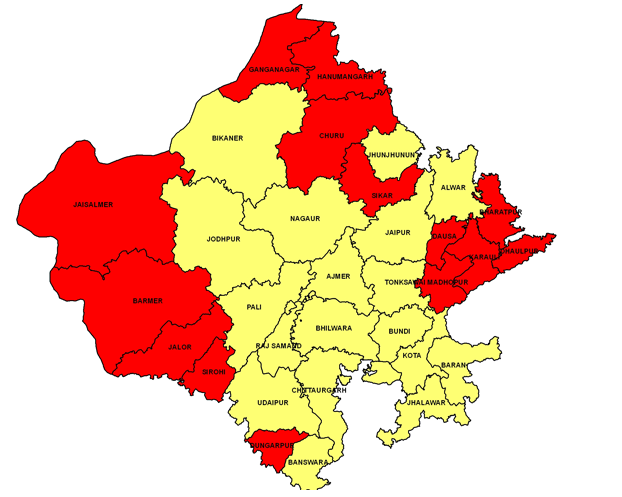
The state of India, Rajasthan, is located in the north-western part of the subcontinent. It is bounded by the states of Punjab and Haryana to the north-east, by the states of Uttar Pradesh and Madhya Pradesh to the east and south-east, by the state of Gujarat to the south-west and by Pakistan to the west and north-west. Jaipur is the capital in the east-central part of the state.
Rajasthan, meaning “abode of kings”, was earlier called Rajputana, “country of Rajputs”. Before 1947, when India gained independence from British rule, it consisted of two dozen native princely states and principalities, the small British-administered province of Ajmer-Merwara and some areas outside the main borders. It assumed its present form on November 1, 1956, when the State Reorganization Act came into force. Area 132,139 sq mi (342,239 sq km). pop (2011) 68,621,012.
Land
Relief
The Aravali (Aravalli) range forms a line almost across the state from Guru Peak (about 5,650 ft [1,722 m]), near Abu (Mount Abu) in the south-west, near Khetari town in the north-east. About three-fifths of the state lies in the north-west of this line, which is two-fifths in the south-east. Rajasthan has two natural divisions. The northwestern tract is generally dry and unproductive, although its character gradually changes from desert in the far west and north-west to relatively fertile and habitable land eastward. The region includes the Thar (Great Indian) Desert.
The southeastern region is located at a slightly higher elevation (330 to 1,150 feet [100 to 350 m]) than its northwestern counterpart; It is also more fertile and has a more varied topography. The hilly tract of Mewar is in the southern region, while a broad plateau extends to the southeast. In the north-east, a rugged rugged area follows the course of the Chambal river. In the north the country is flat in the plains which are part of the alluvial basin of the Yamuna River.
Drainage
Arvallis is the most important watershed of Rajasthan. East of this range, the Chambal river – the only major and perennial river in the state – and other waterways generally flow towards the northeast. The Chambal, a major tributary of the Banas, rises in the Aravalli near the great Kumbhalgarh fort and collects all the drainage of the Mewar Plateau. Farther north, the Banganga, after rising near Jaipur, flows east towards the Yamuna before disappearing. The Luni is the only important river west of the Aravalli. It rises near the city of Ajmer in central Rajasthan and flows 200 miles (320 km) west-southwest into the Rann of Kutch in the state of Gujarat. Northeast of the Looney Basin is an area of internal drainage characterized by salt lakes, the largest of which is the Sambar Salt Lake. Far to the west lies the true desert (“land of the dead”), the barren wasteland and sand dunes that form the heart of the Thar Desert.
Soil
In the vast sandy northwest region, the soil is predominantly saline or alkaline. Water is rare, but is found at depths of 100 to 200 feet (30 to 60 m). Soils and sands are calcareous (chalky). Nitrates in the soil increase its fertility, and cultivation is often possible where an adequate water supply is provided.
The soil in central Rajasthan is sandy; The clay content varies between 3 and 9 percent. In the east, soils vary from sandy loam to loamy sand. In the Southeast, they are usually black and dark in color and are well drained. In the south-central region, the trend is towards a mixture of red and black soils in the east and red to yellow soils in the west.
Climate
Rajasthan has a wide range of climates ranging from extremely dry to humid. The humid zone extends to the south-east and east. Except in the hills, the heat during summer is great everywhere, with temperatures in June—the hottest month—typically rising from the mid-80s (about 30 °C) to about 110 °F (low 40s C) daily. Hot winds and dust storms occur in summer, especially along desert routes. In January – the coldest of the winter months – daily highs range from the upper 60s to mid-70s F (mid to mid-20s), while lows are usually in the mid-40s (about 7°C). The Western Desert averages less than 4 inches (100 mm) of rain. In the Southeast, however, some areas may receive as much as 20 inches (500 mm). Southeast Rajasthan benefits from southwest (summer) monsoon winds from the Arabian Sea and Bay of Bengal branches, which bring the bulk of the annual rainfall.
People
Population Structure
The majority of Rajasthan’s population consists of Indians from various social, professional and religious backgrounds. The Rajputs, although representing only a small percentage of the inhabitants of Rajasthan, are perhaps the most notable segment of the population; In fact, the state takes its name from this community. In terms of caste structure, the Brahmins (highest caste) are divided into several gotras (lineages), while the Mahajanas (merchant caste) are divided into a number of groups. In the north and west, Jats (farmers) and Gujars (shepherds) are among the largest agricultural communities.
Tribal people constitute one tenth of the population of Rajasthan. In the eastern part of the state, these groups include the Meena (and related Meos), most of whom are farmers; Banjaras, known as itinerant traders and artisans; and the Gadiya Lohars, another historically driven tribe, who traditionally repair agricultural and domestic implements. The Bhils are one of the oldest communities in India, who generally reside in southern Rajasthan and have a history of great skill in archery. Gracia and Kathori also live mostly in the south, mostly in the Mewar region. Saharan communities are found in the southeast, and Rabari, who are traditionally cattle breeders, live west of the Aravalli in west-central Rajasthan.
Hindi is the official language of the state, and to some extent it has kept an eye on the local languages of Rajasthan. The majority of the state’s population, however, speak Rajasthani languages, which include a group of Indo-Aryan languages and dialects derived from Dingal. The four main Rajasthani language groups are Marwari in western Rajasthan, Jaipuri or Dhundhari in the east and southeast, Malvi in the southeast, and Mewati in the northeast, which shines in Braj Bhasa (a Hindi dialect) along the border to the north.
Hinduism, the religion of the majority of the population, is generally practiced through the worship of Brahma, Shiva, Shakti, Vishnu and other gods and goddesses. The city of Nathdwara in southern Rajasthan is an important religious center of the Vallabhacharya school of Krishna worshippers.
Islam, the second largest religious community in the state, expanded into Rajasthan in the late 12th century with the conquest of the city of Ajmer and the surrounding area by Muslim invaders. The Muslim missionary and fakir Khwaja Muhan al-Din Chishti had his headquarters at Ajmer, and Muslim merchants, artisans and soldiers settled there.
Jainism is also important; It is not the religion of the rulers of Rajasthan, but the followers among the business class and the wealthy sections of the society. The cities and temples of Mahavirji, Ranakpur, Dhulev, and Karera are major centers of Jain pilgrimage. Another important religious community was formed by the Dadupanthis, the 16th-century followers of Saint Dadu, who preached the equality of all men, strict vegetarianism, absolute abstinence from intoxicating liquor, and lifelong celibacy. The population of Christians and Sikhs in the state is small.
Colonization
Rajasthan is the least populated state in India, with about three-fourths of its population living in rural settlements. Traditional rural houses are huts with mud walls and thatched roofs with a single door but no windows or ventilators. In larger villages, the houses of more affluent farmers and artisans have more than one room.
Since the late 20th century, the urban population of the state has been growing faster than the rural population. Jaipur is the largest city in Rajasthan. Other major urban centers include Jodhpur, Kota, Bikaner, Ajmer and Udaipur. Except for Jodhpur and Bikaner, all are located east of the Aravalli range.
Economy
Agriculture
The agricultural sector is the mainstay of Rajasthan’s economy, accounting for nearly two-thirds of the state’s working population. Despite the scattered rainfall, almost all types of crops are grown here, including pearl millet in the desert region, the area around Kota and mainly maize (maize) around Udaipur. Rice is grown in the irrigated areas of both the south-east and north-west. Cotton and tobacco are important cash crops. Rajasthan has a large livestock population and is a major wool producing state. It is also a source of various breeds of camels and draft animals.
Rajasthan needs extensive irrigation to be agriculturally productive. The state receives water from rivers in Punjab, from the Western Yamuna Canal in Haryana and the Agra Canal in Uttar Pradesh, and from the Sabarmati and Narmada Sagar projects in Gujarat and Madhya Pradesh respectively. The desert lands in northwestern and western Rajasthan are irrigated by the Indira Gandhi Canal (formerly known as the Rajasthan Canal), which carries about 400 miles (640 km) of water from the Beas and Sutlej rivers in Punjab. shares the Bhakra Nangal Project with Rajasthan, Punjab and Haryana and the Chambal Valley Project with Madhya Pradesh; Both are used for irrigation and for supplying water for drinking purposes.
Resources and power
Rajasthan is an important producer of lead and zinc concentrates, emeralds and garnets. A major part of the country’s gypsum and silver ore is also produced in Rajasthan. Power supply is mostly obtained from neighboring states and the Chambal Valley Project. Electricity is mainly generated from hydroelectric stations and gas-fired thermal plants. The state also draws part of its energy from wind farms and a nuclear power plant at Rawatbhata near Kota.
Manufacturing
Textiles, vegetable oil, wool, minerals and chemicals are the major producers of Rajasthan. However, handicrafts such as leather goods, marble work, jewellery, pottery and embossed brass have earned a lot of foreign exchange. Kota, the industrial capital of the state, has a nylon factory and a precision-tool factory, as well as plants for the manufacture of calcium carbide, caustic soda and rayon tire cord. There is a zinc smelter plant near Udaipur.
Government and society
Constitutional framework
Rajasthan’s government structure, like most other states in India, is determined by the 1950 National Constitution. The Chief Executive is the Governor, who is appointed by the President of India for a term of five years. The Governor has administrative, legislative, financial and judicial powers. There is a Vidhan Sabha (Legislative Assembly) in Rajasthan; Members are elected by universal adult suffrage, although some seats are reserved for representatives of tribal groups and other traditionally disadvantaged communities.
The state is divided into more than 30 districts. In each district the Collector, who is also the District Magistrate, is the chief representative of the administration. The Collector works in close collaboration with the Superintendent of Police to maintain law and order in the district and also acts as the Chief Revenue Officer. For administrative purposes, each district is divided into a number of subdivisions, which are divided into smaller units called tehsils, which, in turn, contain several villages.
Rajasthan was the first state to experiment with panchayat raj (rule by a panchayat or village council) at the rural level, which in 1959 enacted the necessary legislation to implement this bold experiment in democratic decentralization. Adopting Gandhian concepts of the importance of traditional village institutions in Indian society, the system created three elected Gram Panchayats at the local level within the state. Villages are divided into administrative units called community development units, each with a Panchayat Samiti (Block Council) consisting of Panchayat presidents, members, and ex-officio members. There were district-level councils (Zilla Parishads) with presidents of panchayat committees as well as representatives of special interest groups (such as women and disadvantaged social classes) and local members of state and national compacts. The main level in this organization was the Community Development Section, which was entrusted with the responsibility of planning and implementing a wide range of community and development programmes. Panchayat Raj initially achieved a large measure of success, but, due to increasing politicization of the system and conflicting interests with state-level development agencies, the system has become less effective.
Health and education
Rajasthan has many hospitals and dispensaries offering allopathic (Western) medicine as well as Ayurvedic (traditional Indian), Unni (a medicinal system using prescribed herbs and shrubs), and homeopathic treatment. The state participates in major national health programs to control tuberculosis, various vector-borne diseases, leprosy, iodine deficiency and blindness.
There are many institutes of higher education in Rajasthan. State universities are located in Jaipur, Udaipur, Jodhpur, Bikaner and Ajmer. Other major tertiary institutions include the Open University in Kota and the Birla Institute of Technology and Science in Pilani.
Cultural life
Art & literature
Rajasthan has a rich tradition of both oral storytelling and written literature. The most famous song is “Kurja”, which tells the story of a woman who wishes to send a message to her absent husband by a Kurja (a type of bird), who is promised a priceless reward for his service. In the literary tradition, Chand Bardai’s epic poem Prithviraj Raso (or Chand Raisa), the earliest manuscript of which dates back to the 12th century, is particularly notable.
Dance
A typical dance of Rajasthan is Ghoomar, which is performed only by women on festive occasions. Other famous dances include the Jer, performed by men and women; Panihari, a beautiful dance for women; And Kachhi Ghori, in which male dancers ride dummy horses. Khayal, a type of dance-drama composed in verse with festive, historical, or romantic themes, is also widely popular.
Art and Architecture
Rajasthan hates antiquarian items. Early Buddhist inscriptions and carvings are found in caves in the southeastern district of Jhalawar; There are many Muslim mosques and tombs in the area around Ajmer, the oldest of which date back to the late 12th century; And Bikaner, in the north west, has a magnificent 15th century Jain temple. Magnificent palace, many wall paintings decorated with flowers, scattered throughout the state.
Ceremony
Cultural life in Rajasthan is characterized by many religious festivals. The most popular of these celebrations is the Gangor festival, during which clay images of Mahadevi and Parvati (representing the benevolent aspects of the Hindu Mother Goddess) are worshiped by women of all castes for 15 days and then immersed. the water Another important festival held in Pushkar near Ajmer takes the form of a mixed religious festival and livestock fair; Hindu pilgrims come in search of salvation during the festival, while farmers from all corners of the state bring their camels and cattle to show and sell. The tomb of the īfī mystic Khwaja Muhan al-Din Chishti in Ajmer is one of the holiest Muslim shrines in India. On the occasion of the death anniversary of the saints, hundreds of thousands of pilgrims, pilgrims from many foreign countries come.