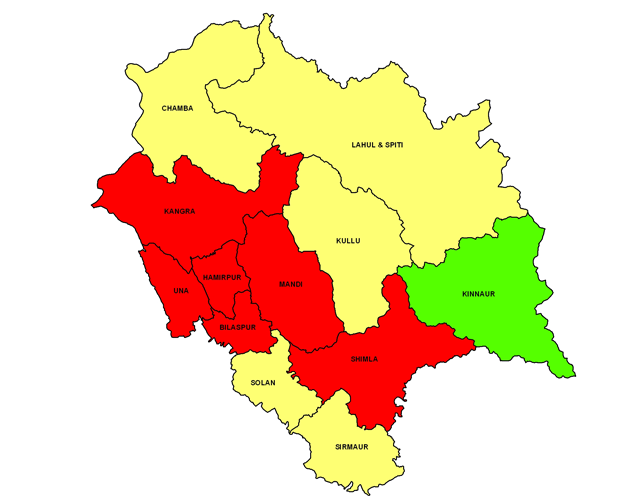
Himachal Pradesh is located in the extreme northern part of the Indian subcontinent. It is bounded by the state of Jammu and Kashmir in the north, Tibet Autonomous Region of China in the east, Uttarakhand and Haryana in the south, and Punjab in the west. Himachal Pradesh occupies a region of natural splendor in the Western Himalayas, offering a multifaceted display of rugged snow-capped mountains, deep valleys, densely forested valleys, large lakes, terraced fields, and cascading streams. Indeed, the name of the state refers to its establishment; The meaning of Himachal is “snowy slope” (Sanskrit: hesa, “snow”; अकाल, “slope”), and the meaning of प्रेदेश is “state.”
The city of Shimla was the predestined summer headquarters of the British Viceroy; It is now the state capital and is located at an elevation of about 7,100 feet (2,200 m), one of the largest and most popular mountains in the country. Formerly a union territory, Himachal Pradesh became a state of India on January 25, 1971. Area 21,495 sq mi (55,673 sq km). pop (2011) 6,856,509.
Land
Relief and drainage
Within the diverse terrain of Himachal Pradesh are several parallel physical zones corresponding to the north-south-southeast-trending ranges of the Himalayan mountain system. The region adjacent to the plains of Punjab and Haryana consists of two sections of the Siwalik (Shiwalik) Range (Outer Himalayas), separated by long, narrow valleys. Elevations in the southern tract of the region average about 1,600 feet (500 m), while in the northern tract they range between 3,000 and 5,000 feet (900 and 1,500 m). North of the Siwaliks are the Himalayas (or Lower Himalayas), which rise to about 15,000 feet (4,500 ft). Within this region are the magnificent snow-capped Dhola Dhar and Pir Panjal ranges. In the north again lies the Zaskar Range, which reaches a height of over 22,000 feet (6,700 m), higher than any other range in the region. Many active mountain glaciers originate in this region.
Apart from the four major water bodies in Himachal Pradesh, there are several perennial glacial rivers and streams. The eastern part of the state is mainly drained by the Sutlej River, which rises in Tibet. In the western part of Himachal Pradesh are the Chenab (Chandra-Bhaga), Ravi, and Beas rivers, which have their sources in the Great Himalayas.
People
Population Structure
The population of Himachal Pradesh is made up of various ethnic groups and social castes. Among the most prominent communities are Gaddi (Gaddi), Gujri, Kinnauri, Lahuli and Pangwali. Since Indian independence in 1947, many Punjabi immigrants have settled in major towns and cities.
The majority of the population is Hindu, although Buddhists form major groups in the populated districts of Lahaul-Spiti and Kinnaur, both of which share a border with Tibet. There are also small minorities of Sikhs, Muslims and Christians in the state.
Although every former princely state has a local dialect within Himachal Pradesh, Hindi (the official state language) and Pahari are the dominant languages. Both are Indo-Aryan languages. In Lahaul-Spiti and Kinnaur, however, the most commonly spoken languages belong to the Sino-Tibetan family.
Method of disposal
Himachal Pradesh is one of the least urbanized states in India. At the beginning of the 21st century, its urban population was less than 10 percent of the total. There are more than 50 cities, and the capital, Shimla, is a city of reasonable size. Former princely capitals including Bilaspur, Mandi, Chamba, and Kullu are now district headquarters. Dalhousie, Kasauli and Sabathu are hill resorts of British origin. Kangra, Palampur, Solan, and Dharamshala are other notable cities of the state.
Economy
Agriculture and manufacturing
Most of the people in Himachal Pradesh depend on agriculture, animal husbandry, transhumance (seasonal rearing), horticulture and forestry for their livelihood. However, the government of Himachal Pradesh has encouraged manufacturing and development in various cities as well as in the southern part of the state, especially with specialization in goods manufacturing. Nahan city, for example, is known for its production of agricultural implements, turpentine, and resin, while television sets, fertilizers, beer, and liquor are among Solan’s major manufactures. Meanwhile, Rajban is identified with cement production, and Parwanu is identified for its processed fruits, tractor parts and electronics. Shimla is also known for manufacturing electrical goods, while paper and hardboard products usually come from Baddi and Barotiwala. Along with the development of heavy industry, thousands of artisan-based small-scale manufacturing units remain operational throughout the state.
Resources and power
The state has implemented a series of development schemes based on its abundant hydropower potential and utilization of mineral and forest resources. Himachal Pradesh produces a significant portion of India’s hydroelectric power. Existing hydroelectric plants include a station on the Ulh River at Jogindranagar, Vishal Bhakra Dam on the Sutlej River, Pong Dam on the Beas River and Giri Dam on the Giri River. Himachal Pradesh has also worked on joint venture hydropower projects with the central government, such as the large Nathpa Jhakri project in Shimla district. To combat a serious soil-erosion problem in the Siwaliks and protect the fragile Himalayan ecosystem, the state has launched a redevelopment programme. It has also established strict enforcement of environmental laws.
Transportation
Despite its remote location, Himachal Pradesh has a very well-developed infrastructure, which not only has domestic mobility, but has also helped promote tourism. Visible narrow gauge railway lines run from Kalka to Shimla and from Pathankot (in Punjab) to Jogindranagar. There is also a railhead in Una. Roads, however, serve as the communication lifeline of Himachal Pradesh, passing between mountain ranges and valleys; The state operates several bus routes across the network. Regular domestic air services are available to Shimla and Kullu.
Government and society
Constitutional framework
The basic governmental structure of Himachal Pradesh, like most other Indian states, is determined by the national constitution of 1950. The state government is headed by a Governor appointed by the President of India. The Council of Ministers, chaired by a Chief Minister and responsible to the directly elected Vidhan Sabha (Legislative Assembly), assists and advises the Governor.
The state is divided into several districts, each of which is headed by a Deputy Commissioner. Districts, in turn, consist of many subdivisions, which adopt many more levels of local administration. The smallest (and most important) administrative unit is the village.
Education
Since the late 20th century, Himachal Pradesh has made many efforts to expand education. As a result, there has been a significant increase in the number of primary, secondary and post-secondary institutions and enrollment at all levels has increased.
Himachal Pradesh University, established in 1970 in Shimla, was the state’s first higher education institution; It now has dozens of affiliated colleges. Other major tertiary institutions include a medical college in Shimla, an agricultural university in Palanpur, an engineering college in Hamirpur, a university of horticulture and forestry near Solan, and an information technology university. Besides its universities and colleges, Himachal Pradesh has some important research centers, notably the Indian Institute of Advanced Studies in Shimla and the Central Research Institute in Kasauli.
Cultural life
The fairs and festivals of rural communities provide many opportunities for the performance of songs, dances and colorful costumes. Kullu Valley, known as the Valley of the Gods, provides the setting for the Dussehra festival held each autumn to celebrate the defeat of the demon king, Ravana, by Prince Rama (described in the ancient Hindu epic Ramayana). During the festival, various temple deities are taken in procession in covered palanquins, accompanied by bands of singers and dancers. Participants in this and other such ceremonies are usually dressed in vibrant attire, often accented with beautifully designed shawls from the Kinnaur district, finely embroidered handkerchiefs from Chamba, or distinctive woolen hats from Kullu.
Pilgrims from neighboring states and from within Himachal Pradesh itself come in large numbers to worship at the temples of mythological antiquity. The city of Dharamshala has recently emerged as a holy site, especially for Tibetan Buddhists; In Dharamshala, the Dalai Lama fled from Tibet in 1959 and settled in Lhasa after the Chinese occupation.
Apart from their festivals and holy places, the hills of Shimla, Kullu Valley (including the city of Manali), and Dalhousie are popular tourist destinations, especially for outdoor recreation. In fact, skiing, golfing, fishing, trekking and mountaineering are among the activities for which Himachal Pradesh is ideally suited.
History
The history of this hill state is complex and fragmented. It is known that during the Vedic period (c. 1500 to 500 BCE) several so-called Aryan groups raided the more productive valleys and assimilated the pre-Aryan populations. Later, successive Indian empires – such as the Mauryas (c. 321–185 BCE), the Guptas (c. 320–540 CE), and the Mughals (1526–1761), all sought to emerge in the Indo-Gangetic plain. The degree of control over trade and pilgrimage routes between India and Tibet in this region and across the Himalayas varies.
At the time of Indian independence in 1947, there was a movement to end feudalism in the region, and the princely state of Suket surrendered to peaceful protesters. Subsequently, Himachal Pradesh was formed as a province in 1948. It consisted of 30 princely states and was administered by a Chief Commissioner.
Between its achievement of statehood in 1948 and 1971, Himachal Pradesh underwent various changes in size and administrative form. It became a substitute under the Indian Constitution of 1950. In 1954 it merged with Bilaspur (a former Indian state and then a Chief Commissioner’s Province), and in 1956 it became a Union Territory. Himachal Pradesh was expanded in 1966 by the merger and absorption of several Punjabi hill regions, including areas around Shimla, Kangra, and Kullu; District of Lahaul-Spiti; Parts of the districts centered in Ambala, Hoshiarpur, and Gurdaspur. In early 1971, Himachal Pradesh became India’s 18th state; YS Parmar, who had been a leader in the quest for self-rule in Himachal Pradesh since 1940, became the state’s first Chief Minister.