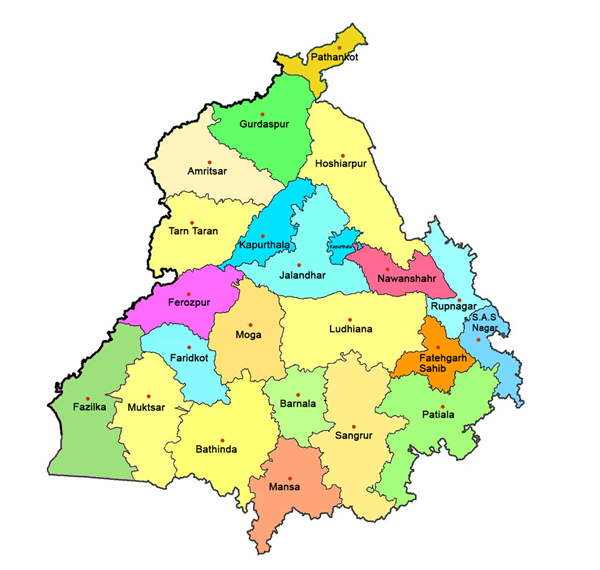
The state of Punjab is located in the north-western part of the Indian subcontinent. Punjab is bordered by Jammu and Kashmir to the north, Himachal Pradesh to the northeast, Haryana to the south and southeast, Rajasthan to the southwest and Pakistan to the west. The present form of Punjab came into being on November 1, 1966, when its predominantly Hindi-speaking region was seceded to form the new state of Haryana. Chandigarh city is the joint capital of Punjab and Haryana.
The word Punjab is a compound of two Persian words, panj (“five”) and aab (“water”), thus denoting the land of five waters, or rivers (Beas, Chenab, Jehlum, Ravi, and Sutlej). The origin of the word can probably be traced to the Sanskrit word panka nada for “five rivers” and the name of a region described in the ancient epic Mahabharata. The name of the present Indian state of Punjab has remained a misnomer because since the partition of India in 1947, only two of the five rivers, the Sutlej and the Beas, are located in Punjab’s territory, while the Ravi flows only along its western border. Area 19,445 sq mi (50,362 sq km). pop (2011) 27,704,236.
Land
Relief, drainage and soil
Punjab is spread over three physical regions. The shortest is the Shivalik range in the northeast, where the elevation reaches about 3,000 feet (900 ft). Farther south, narrow, emerging foothills are dissected by adjacent weather ridges, many of which terminate in the plain below without joining any stream. To the south and west of the foothills is a broad flat tract, with low-elevation floodplains separated by slightly elevated areas. The area, with its fertile alluvial soil, slopes gently from an elevation of about 900 feet (275 m) in the northeast to about 550 feet (170 m) in the southwest. The southwestern part of the plains, which was formerly surrounded by sand dunes, has been leveled mostly with the expansion of irrigation projects.
Climate
Punjab has an inland subtropical location, and its climate is continental, semi-arid and sub-humid. Summers are very hot. In the hottest month, June, daily temperatures in Ludhiana usually reach a maximum of 100 °F (upper 30s C) and a minimum of 70s F (mid 20s C). In the coldest month, January, daily temperatures typically range from the mid-40s (around 7 °C) to the mid-60s (upper 10 °C). Annual rainfall is highest in the Siwalik Range, which can exceed 45 inches (1,150 mm), while the southwestern region of the state receives the lowest, about 12 inches (300 mm); The statewide average annual precipitation is about 16 inches (400 mm). Most of the annual rainfall occurs during the southwest monsoon months, from July to September. Winter rains from western cyclones, from December to March, account for less than one-fourth of the total rainfall.
Plant and animal life
Over the centuries, Punjab has cleared most of its forest cover for the development of human settlement. In large parts of the Siwalik range, shrub vegetation has replaced trees as a result of extensive deforestation. Efforts are being made to redevelop the hills and Eucalyptus trees have been planted along major roads.
Natural habitats for wildlife are severely limited due to intense competition from agriculture. However, several species of rodents (such as rats, squirrels, and gerbils), bats, birds, snakes, and some species of monkeys have adapted to farm environments. Siwalik includes giant mammals, jackals, leopards, wild boars, various types of deer, civets and pangolins (scaly).
People
Population Structure
The people of Punjab are mainly descendants of the so-called Aryan tribes who entered India from the north-west during the second millennium BC, as well as the Aryan population, probably the Dravidians (speaking Dravidian languages), who had a highly developed civilization. Remnants of this civilization have been discovered in Rupnagar (Ropad). Successive waves of invaders – Greeks, Parthians, Kushans, and Hephthalites (Huns) – contributed to the diversity of earlier social, or caste, groups (jati). Later, Islamic invaders forced many disadvantaged groups (such as the Jat peasant caste and the Rajput class of the zamindars) to convert to the Muslim faith, although many conversions were voluntary under the influence of Sufi saints.
Today, however, the majority religion of Punjab is Sikhism, which originated from the teachings of the first Sikh, Guru Nanak. Hindus form the largest minority religion, but Muslims also have a significant population. There are small communities of Christians and Jains in some areas.
Punjabi is the official language here. Punjabi is most widely spoken here along with Hindi. However, many people also speak English and Urdu.
Method of disposal
About one-third of Punjab’s population lives in cities and towns. Its major cities are: Ludhiana in the central region, Amritsar in the northwest, Jalandhar in the north-central Punjab, Patiala in the southeast, and Bathinda in the south-central part of the state. Muslims mostly live in and around the south-west-central city of Maler Kotla, which was once the center of a princely state ruled by a Muslim Nawab (provincial governor).
Economy
Agriculture
Some two-thirds of Punjab’s population is engaged in agriculture, which accounts for a significant portion of the state’s gross product. Punjab produces a significant portion of India’s food grains and contributes a large share of wheat and rice stocks held by the Central Pool (a national storage system of surplus food grains). Much of the state’s agricultural progress and productivity is attributed to the so-called Green Revolution. The Green Revolution is an international movement that began in the 1960s that included not only new agricultural techniques, but also high-yielding varieties of wheat and rice.
Apart from wheat and rice, maize (maize), barley and pearl millet are important cereal products of Punjab. Although the yield of pulses (legumes) has declined since the late 20th century, the commercial production of fruits has increased rapidly, especially citrus, mango and guava. Other major crops include cotton, sugarcane, oilseeds, chickpeas, groundnuts (peanuts) and vegetables.
Punjab is one of the most irrigated states of India. Government-owned canals and wells are the main sources of irrigation; Canals are most common in southern and southwestern Punjab, while wells are more common in the north and northeast. The Bhakra Dam project in the neighboring state of Himachal Pradesh provides plenty of water for irrigation to Punjab.
Manufacturing
The manufacturing sector (including construction) has expanded in Punjab since the late 20th century. Those producing silk, wool and other textiles in industries with the largest number of workers; processed foods and beverages; Metal products and machinery; transport equipment; And furniture manufacturers are included. Other important manufacturing includes leather goods, chemicals, rubber and plastics and hosiery.
Services
Punjab’s service sector includes trade, transportation and warehousing, financial services, real estate, public administration and other services. This region has developed rapidly since the late 20th century. By the beginning of the 21st century, it had become the largest component of Punjab’s economy.
Transportation
Punjab has the best developed road network in the country. All-weather paved roads extend to most villages, and several national highways cross the state. Punjab Northern Railway is part of the National Railway System. There are international airports at Amritsar and Chandigarh, and regular domestic service is available at Ludhiana. Many other airports offer cargo services.
Government and society
Constitutional framework
The structure of government of Punjab, like most other states of India, is determined by the national constitution of 1950. The state is headed by a Governor, who is appointed by the President of India. The Governor is advised by the Council of Ministers, which is headed by a Chief Minister and is responsible to the unicameral Vidhan Sabha (Legislative Assembly).
At the head of the judiciary is the High Court, which is located in Chandigarh and is shared with the state of Haryana. Appeals from the High Court are directed to the Supreme Court of India. Below the High Court are the district level courts.
The state is divided into more than a dozen districts, which are divided into several revenue divisions. Each district is headed by a Deputy Commissioner. Districts are further divided into several tehsils, or subdivisions. Lower administrative and revenue units include mandals, blocks and villages, as well as police districts and police stations.
Health and wellness
Health status in Punjab is better than most states of India. Medical colleges, district- and tehsil-level medical facilities, health care centers in rural areas and hospitals affiliated with several dispensaries form a comprehensive health care network.
Many social services are provided by the government and voluntary organizations. The government provides pensions for the elderly and operates a network of employment clearinghouses to assist the unemployed. The state also plans to assist people from traditionally disadvantaged social groups through blended loans and grants for scholarships, employment services, and vocational activities.
Education
Apart from the government, private organizations have played an important role in the expansion of education at primary, secondary and tertiary levels across the state. Education is compulsory and free for students aged 6 to 11. Secondary education is also free in government schools. Broadcasting has been particularly important in the expansion of vocational and cultural education throughout the state.
Punjab has several state universities including Punjabi University in Patiala (1962), Guru Nanak Dev University in Amritsar (1969), Punjab University in Chandigarh (1956), Punjab Agricultural University in Ludhiana (1962), Punjab Technical University in Jalandhar (1997), Baba Farid University of Health Sciences in Faridkot (1998) and more than 200 specialized colleges and technical institutes.
Cultural life
Love and war songs, fairs and festivals, dance, music and Punjabi literature are among the distinctive expressions of the cultural life of the state. Punjabi literature originated in the mystical and religious poetry of the 13th century Sufi (mystic) Sheikh Farid and the 15th-16th century founder of Sikhism, Guru Nanak; Among those forms, Punjabi was first used as a medium of poetic expression. The works of Sufi poet Waris Shah greatly enriched Punjabi literature in the late 18th century. In contemporary Punjabi literature of the 20th and early 21st centuries, poets and writers Bhai Veer Singh and poet Puran Singh, Dhani Ram Chatrik, Mohan Singh “Mahir,” and Shiv Kumar Batalvi found some of his greatest companions; Famous novelists include Jaswant Singh Kanwal, Gurdayal Singh, Giani Gurdit Singh and Sohan Singh Sheetal. Kulwant Singh Virk is one of the most famous writers of short stories in Punjabi.
Punjab has many religious and seasonal festivals, such as Dussehra, a Hindu festival celebrating the victory of Prince Rama over the demon king Ravana, as described in the epic Ramayana; Diwali, the festival of lights celebrated by Hindus and Sikhs; And Baisakhi, which is a New Year’s festival for Hindus and an agricultural festival for Sikhs and the celebration of the birth of the community’s Khalsa Order. There are many anniversary celebrations in honor of the Gurus (10 historical leaders of Sikhism) and various saints. Dancing with Bhangra, Jhumar, and Sammy in the most popular styles is a distinctive feature of such celebrations. Punjabi, a native Punjabi tradition, is a comic song and dance style performed by Gidda women. In addition to Sikh religious music, semi-military Mughal forms, such as Khayal dance and vocal performance styles of ghumri, ghazal, and qawwali, continue to be popular.
The state’s outstanding architectural monument is the Harmandir Sahib (Golden Temple) in Amritsar, which blends Indian and Muslim styles. Its main motifs, such as domes and geometric designs, are repeated in most Sikh places of worship. Harmandir Sahib is rich in gold work, panels with floral designs and marble facades with colored stones. Other important buildings include the Shaheed Smarak at Jallianwala Bagh (a park in Amritsar), the Hindu temple of Durgiana (also in Amritsar), the so-called Moorish Mosque at Kapurthala (modelled after a Moroccan model) and the old fort at Bathinda.
History
The foundation of the present Punjab was laid by Banda Singh Bahadur, a military leader who, along with a war band of Sikhs, temporarily liberated the eastern part of the province from Mughal rule in 1709-10. After the defeat and execution of Banda Singh in 1716, there was a prolonged conflict between the Sikhs and the Mughals. By 1764-65, the Sikhs had established their dominance in the region. Ranjit Singh (1780-1839) later built the Punjab region into a powerful Sikh empire and annexed the neighboring provinces of Multan, Kashmir and Peshawar (now wholly or partially administered by Pakistan).
In 1849, the troops of the British East India Company dominated the state of Punjab and later Punjab became a province under the British rule. By the end of the 19th century, however, the Indian nationalist movement took hold in the province. One of the most significant events associated with the movement was the 1919 Amritsar Massacre, which resulted in British General Reginald Edward Harry Dyer ordering the firing of a group of some 10,000 Indians who had been summoned to oppose the new anti-mutiny laws; According to one report, about 400 people died in the conflict and about 1,200 were injured. When India gained its independence in 1947, the British province of Punjab was divided between the newly sovereign states of India and Pakistan, and the smaller, eastern portion became part of India.
After independence, the history of Indian Punjab was dominated by the Sikh movement for a separate Punjabi-speaking state, led by Tara Singh and later by his political successor Sant Fateh Singh. In November 1956, however, rather than being divided along linguistic lines, the Indian state of Punjab was enlarged through the incorporation of Patiala and the East Punjab States Union (PEPSU), an amalgamation of the formerly dependent territories of Patiala, Jind, Nabha, Faridkot, Kapurthala, Kalsia, Malerkotla (Maler Kotla), and Nalagarh. Political and administrative leadership for the enlarged Punjab was provided by Sardar Pratap Singh Kairon, Chief Minister of the state from 1956 to 1964. The call for a separate Indian state was made in view of the expansion of Punjab with predominantly Punjabi-speaking areas. Eventually, the Indian government met the demand. On November 1, 1966, Punjab was divided linguistically into the predominantly Hindi-speaking state of Haryana and the new, predominantly Punjabi-speaking state of Punjab; Meanwhile, the northern districts were transferred to Himachal Pradesh, and the newly created city of Chandigarh and its surroundings became a separate union territory. Although Chandigarh was not part of any state, the city of Chandigarh was maintained as the joint administrative headquarters or capital of both Haryana and Punjab.